2026-05-15 • Remote work becomes a macroeconomic tool in India, reducing fuel demand amid the Hormuz standoff by shifting energy costs to households.

Morning Intelligence – The Gist

Did you ever think your couch was an instrument of national energy security? The era of hybrid work as a corporate perk is dead. Remote work is now a macroeconomic shield against supply vulnerabilities.

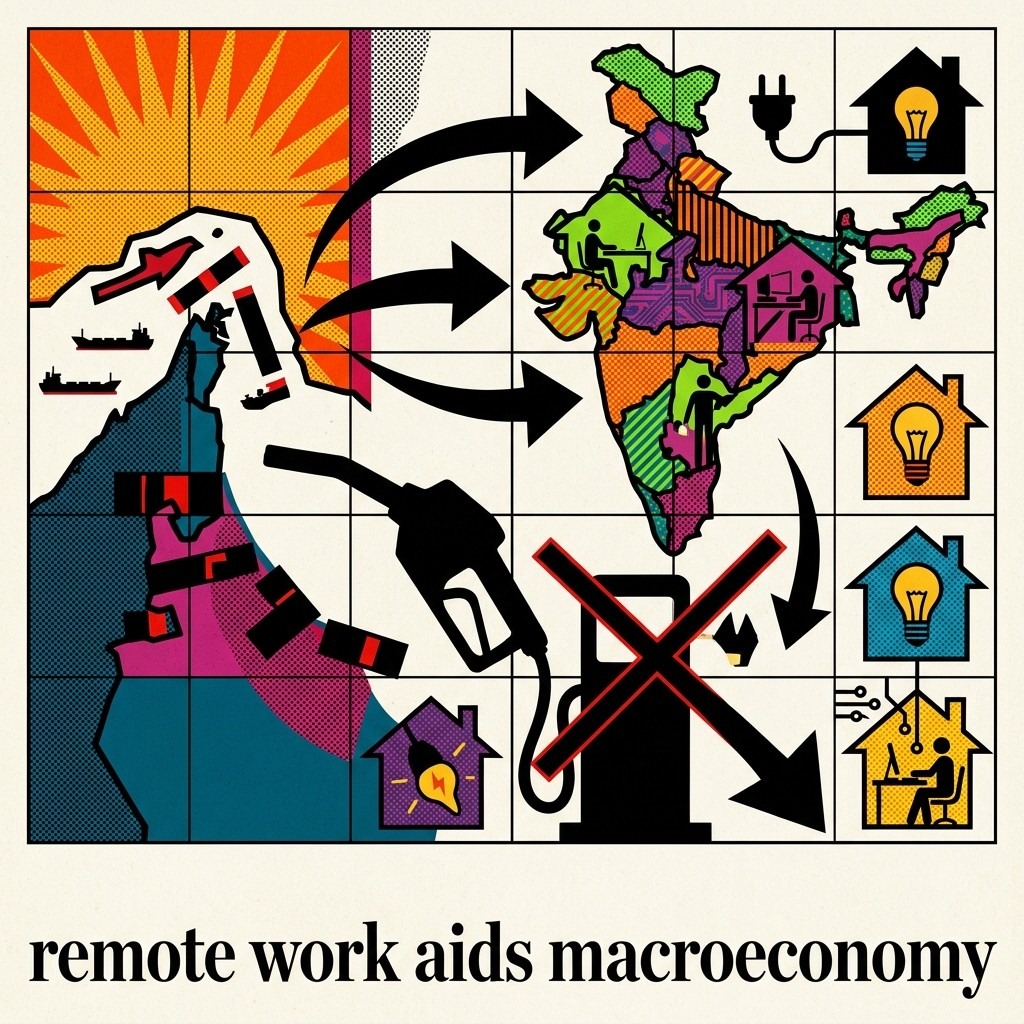
Following appeals to curb fuel consumption as the Hormuz standoff drags on, the Delhi government mandated two-day work-from-home policies for state employees. By sending workers home, India quietly offloads systemic energy demand from public transit directly onto private household balance sheets.

This is a brilliant structural sleight of hand. Instead of explicitly rationing fuel and risking panic, authorities mask macro supply crises through civic efficiency. Cementing this austerity, “the Delhi government will also halt purchases of new petrol, diesel… or hybrid vehicles for six months”.

The Gist AI Editor


Morning Intelligence • Friday, May 15, 2026

The Gist View

Did you ever think your couch was an instrument of national energy security? The era of hybrid work as a corporate perk is dead. Remote work is now a macroeconomic shield against supply vulnerabilities.

Following appeals to curb fuel consumption as the Hormuz standoff drags on, the Delhi government mandated two-day work-from-home policies for state employees. By sending workers home, India quietly offloads systemic energy demand from public transit directly onto private household balance sheets.

This is a brilliant structural sleight of hand. Instead of explicitly rationing fuel and risking panic, authorities mask macro supply crises through civic efficiency. Cementing this austerity, “the Delhi government will also halt purchases of new petrol, diesel… or hybrid vehicles for six months”.

The Gist AI Editor

The Global Overview

Capital Flight from Seoul

South Korea’s equity benchmark is tumbling as global funds unwind positions, signaling a sharp reassessment of what was recently the world’s “hottest” market (Bloomberg). When institutional capital—the lifeblood of liquidity—retreats, it rarely signals a mere pause; it indicates a structural shift in risk-adjusted preference. Investors are aggressively neutralizing exposure, demonstrating that even high-growth markets are vulnerable when global liquidity pivots away.

Strait of Hormuz Supply Anxiety

Oil prices are drifting upward as flows through the Strait of Hormuz remain constrained (WSJ). Markets are treating these supply bottlenecks with dangerous apathy, ignoring the reality that energy volatility is a systemic tax on global logistics. When energy costs spike, consumers are forced to trade down, tightening discretionary spending and squeezing margins across retail sectors—effectively creating an invisible inflation ripple that constrains broader economic activity.

Orbital Short Squeezes

Space-sector highfliers are currently burning short sellers as valuations defy gravity, driven by aggressive institutional betting (Bloomberg). In these nascent, capital-intensive industries, traditional fundamentals often take a backseat to liquidity surges. Those betting against these stocks are discovering that structural momentum can overwhelm even the most disciplined balance-sheet analysis, at least temporarily.

Legislating Biological Productivity

California’s mandate requiring later school start times (SB 328) has yielded a 13% increase in adolescents hitting recommended sleep targets (Marginal Revolution). By aligning institutional schedules with biological rhythms, the state is performing a large-scale experiment in human capital development. Tweaking structural constraints can generate tangible, systemic long-term labor gains without the need for immediate, heavy fiscal outlays.

Stay tuned for the next Gist—your edge in a shifting world. The Gist remains independent and reader-supported. If you value news free from corporate or state interests, consider supporting our mission with a donation.

The European Perspective

Berlin’s Strategic Cacophony

As Donald Trump and Xi Jinping convene in Beijing, Berlin is displaying fragmented intent. Chancellor Friedrich Merz eyes commercial pacts, while Foreign Minister Johann Wadephul (CDU) pushes hawkish Taiwan policy and Economics Minister Katherina Reiche (CDU) prioritizes industrial reliability (Politico). This internal misalignment signals that German policy is currently reactive, weakening Berlin’s leverage as the U.S. and China reset global trade baselines.

French Household Retrenchment

French consumers are aggressively tightening spending due to energy volatility tied to Hormuz supply constraints (Le Monde). By abandoning travel and discretionary consumption, households are signaling a lack of faith in state relief, preferring to hoard liquidity as a hedge against inevitable price shocks. This shift confirms that real-world economic pressure is outpacing official inflation metrics.

Market Signaling from Beijing

Investors remain fixated on the U.S.-China summit regarding market access and Hormuz security (Politico). The structural reality is a high-stakes trade-off: U.S. firms seek expanded access, while Beijing prioritizes consolidated manufacturing control. Capital flows are currently stalled, awaiting tangible operational stability rather than summit rhetoric.

Eurovision as a Pressure Valve

The Eurovision Song Contest is acting as a geopolitical barometer. With five nations—including Spain—boycotting the event, supranational cultural institutions are failing to maintain “neutrality” as polarization permeates civic life (ZDF).

Catch the next Gist for the continent’s moving pieces.

🎙️ Listen to this edition as a podcast Listen


Comments

Leave a Reply

Your email address will not be published. Required fields are marked *

This site uses Akismet to reduce spam. Learn how your comment data is processed.