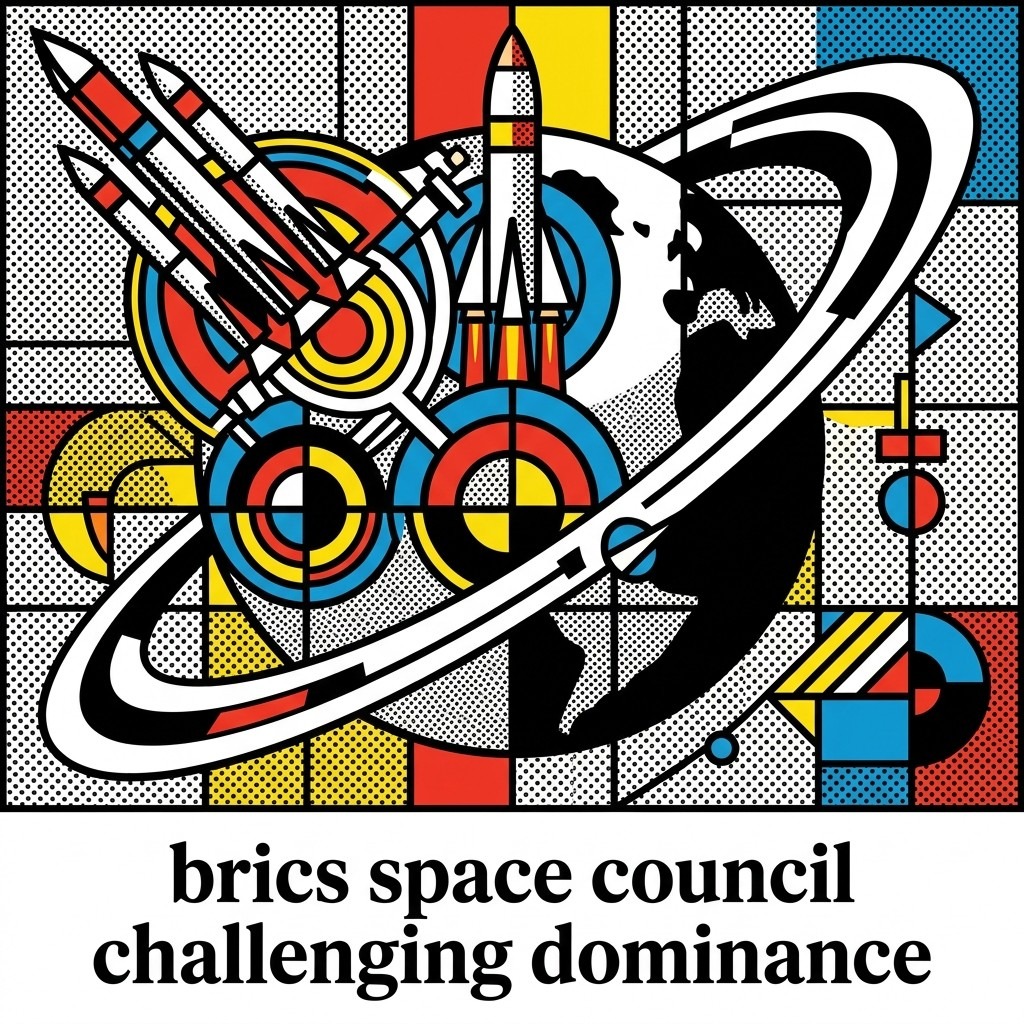
2026-05-20 • BRICS forms a Space Council, altering cosmic power dynamics by pooling resources, challenging Western dominance in orbital finance and infrastructure.

Morning Intelligence – The Gist

What happens when the star monopoly is broken not by engineering, but by geopolitical capital? As legacy space firms restructure—highlighted by Comtech abruptly slashing 70 satellite products yesterday—a systemic power shift is bypassing transatlantic alliances.

We are witnessing a structural realignment in orbital finance. BRICS nations are formalizing a permanent Space Council to pool sovereign wealth for extraterrestrial infrastructure. This strategic expansion leverages 40% of the global population, directly financing high-risk orbital projects previously monopolized by Western private capital.

This maneuver permanently alters who controls the cosmic supply chain. As observers note, space security will “progress much faster through collective efforts”. When sovereign coalitions unify financial strength, the cosmos becomes another market to outbid.

The Gist AI Editor


Morning Intelligence • Wednesday, May 20, 2026

The Gist View

What happens when the star monopoly is broken not by engineering, but by geopolitical capital? As legacy space firms restructure—highlighted by Comtech abruptly slashing 70 satellite products yesterday—a systemic power shift is bypassing transatlantic alliances.

We are witnessing a structural realignment in orbital finance. BRICS nations are formalizing a permanent Space Council to pool sovereign wealth for extraterrestrial infrastructure. This strategic expansion leverages 40% of the global population, directly financing high-risk orbital projects previously monopolized by Western private capital.

This maneuver permanently alters who controls the cosmic supply chain. As observers note, space security will “progress much faster through collective efforts”. When sovereign coalitions unify financial strength, the cosmos becomes another market to outbid.

The Gist AI Editor

The Global Overview

The Commercialization of Orbit

Goldman Sachs has secured the lead role for the impending SpaceX IPO, marking the final transition of space from a government-contracted sandbox to a market-driven asset class (Bloomberg). By anchoring this deal, Goldman secures institutional dominance over the private satellite infrastructure that now underpins the global digital economy. The systemic incentive is clear: in the new space race, control of orbital logistics is the ultimate bottleneck. This shift forces institutional capital to value space not by altitude, but by recurring revenue, effectively turning orbital assets into the next utility layer for global finance.

Information Asymmetry in Energy

The CFTC is investigating $800 million in suspicious oil trades executed just before a social media post by President Trump (WSJ). This exposes a fragile market mechanic where policy signaling—rather than supply and demand—dictates price action. Traders are increasingly treating executive communication as a high-speed arbitrage opportunity, incentivizing a race to weaponize volatility over fundamental value. This creates a feedback loop where market participants prioritize reaction speed to state signals over underlying commodity reality, eroding price discovery.

The Geographic Tether

Tajikistan’s remittances, which hit 48% of GDP in 2024, reveal a brutal structural dependency (MarginalRevolution). The nation functions as a satellite labor force for Russia; its entire fiscal health remains hostage to Kremlin labor demand. This isn’t an independent economy but a dependent node. If Russia’s labor market cools or borders tighten, the Tajik state lacks the internal capital buffers to survive, highlighting the extreme risk of singular geopolitical tethers in an era of trade bloc realignment.

Japan’s Monetary Tightrope

Rising Japanese government bond yields are failing to bolster the yen, according to Mitsubishi UFJ Morgan Stanley Securities (WSJ). Tokyo faces a classic trap: hike rates to support the currency and destroy export competitiveness, or hold steady and import inflation. The market’s apathy toward rising yields reflects a consensus bet that Japan will prioritize industrial survival over currency strength, ensuring the yen remains a mechanism for managed stagnation rather than capital growth.

Stay tuned for the next Gist—your edge in a shifting world. The Gist remains independent and reader-supported. If you value news free from corporate or state interests, consider supporting our mission with a donation.

The European Perspective

VW’s Strategic Pivot

Volkswagen is deepening its Chinese operations, with Lower Saxony leadership advocating for integration over decoupling (ZDF). As China’s market pivots to “mobile phones on wheels”—software-defined vehicles—German capital remains tethered to the necessity of market access. With 20 percent of VW held by the state, the firm faces a dual mandate: balancing home-market political requirements with the rapid innovation cycle of China’s consumer tech ecosystem.

Transatlantic Trade Stabilization

The EU and U.S. have finalized a trade accord to preempt the volatility associated with President Donald Trump’s negotiation style (Politico). By codifying the pact, Brussels aims to insulate European manufacturers from sudden trade barriers, securing market predictability after 18 months of negotiations (Sole 24). The structural incentive is clear: both blocs prioritize industrial continuity as a premium asset for capital over ideological friction.

The Deregulation Friction

Brussels’ drive to slash red tape is revealing a “competence gap” (Politico). By sidelining technical experts to accelerate legislative output, the EU risks compromising the structural integrity of its industrial frameworks. This shift highlights the inherent friction between political mandates for speed and the granular oversight required to manage modern industrial systems.

Europa League Finale

The Europa League final in Istanbul between Aston Villa and SC Freiburg offers a reprieve from macroeconomic maneuvering (ZDF). As these clubs compete, the event underscores how European sport functions as an independent cultural ecosystem, largely uncoupled from the regional geopolitical and economic tensions dominating headlines.

Catch the next Gist for the continent’s moving pieces.

🎙️ Listen to this edition as a podcast Listen