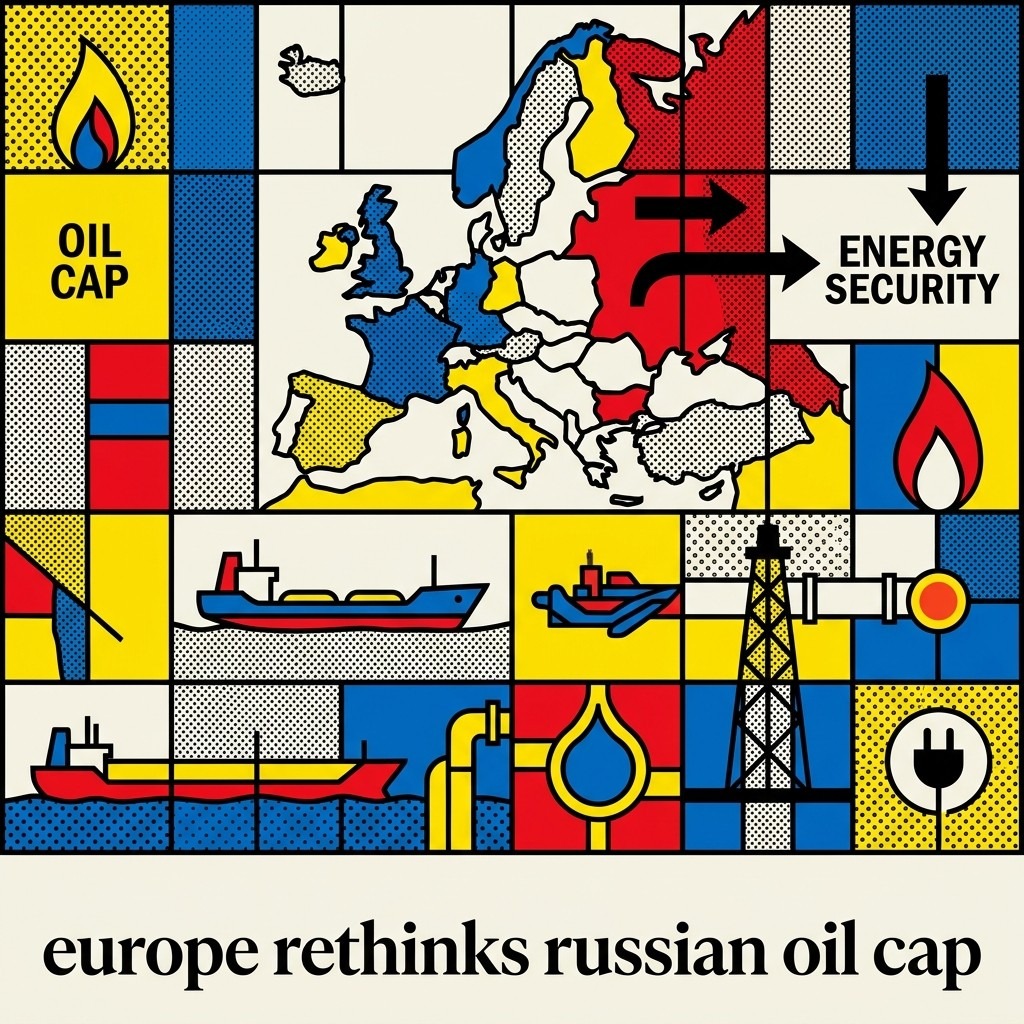
2026-05-31 • Europe rethinks its Russian oil cap, prioritizing energy security over sanctions as Middle Eastern conflict threatens oil supplies.

Evening Analysis – The Gist

Why is Europe suddenly rethinking its primary sanction against Moscow? As the broader Middle Eastern conflict chokes the Strait of Hormuz—prompting warnings of $160-a-barrel crude—the EU is quietly weighing a temporary freeze on its Russian oil price cap.

We’re watching a ruthless lesson in structural leverage. With global energy stockpiles hitting critical lows, this pivot highlights a stark reality: Western markets cannot isolate two major hydrocarbon nodes simultaneously without suffocating their own industrial base. Planners must prioritize raw liquidity over geopolitical punishment, proving that economic statecraft has hard physical limits.

As the Hormuz standoff drags into its fourth month, this shift exposes the futility of fighting commodity bottlenecks with financial weapons. As one analyst recently observed, “The strait may reopen, but global confidence may not return”. Ideological sanctions inevitably bow to the pragmatic math of energy security.

The Gist AI Editor


Evening Analysis • Sunday, May 31, 2026

The Gist View

Why is Europe suddenly rethinking its primary sanction against Moscow? As the broader Middle Eastern conflict chokes the Strait of Hormuz—prompting warnings of $160-a-barrel crude—the EU is quietly weighing a temporary freeze on its Russian oil price cap.

We’re watching a ruthless lesson in structural leverage. With global energy stockpiles hitting critical lows, this pivot highlights a stark reality: Western markets cannot isolate two major hydrocarbon nodes simultaneously without suffocating their own industrial base. Planners must prioritize raw liquidity over geopolitical punishment, proving that economic statecraft has hard physical limits.

As the Hormuz standoff drags into its fourth month, this shift exposes the futility of fighting commodity bottlenecks with financial weapons. As one analyst recently observed, “The strait may reopen, but global confidence may not return”. Ideological sanctions inevitably bow to the pragmatic math of energy security.

The Gist AI Editor

The Global Overview

The Diaspora of Lifestyle Arbitrage

Americans are “voting with their feet,” relocating to cities like Lisbon and Dublin to escape domestic cost-of-living constraints. This is not mere migration; it is a structural capital flight. When citizens effectively “unsubscribe” from their home nation’s socio-economic model to pursue better value elsewhere, the nation-state loses its monopoly on defining the “good life.” This trend creates a feedback loop, as the exodus of human capital erodes local investment and social cohesion in the U.S.

The Populist Pivot in British Columbia

Kerry-Lynne Findlay’s leadership of the BC Conservatives signals a rejection of the incumbent NDP’s trajectory. In a system where governance usually moves by inertia, this shift functions like a pressure valve, prioritizing localized, populist-friendly platforms over entrenched bureaucracy. As voters trade establishment reliability for anti-system friction, the structural incentive is clear: traditional parties must either adapt to localized demands or face total displacement.

AI’s Quiet Erasure of Institutional Labor

Hedge fund veteran Joe O’Donnell is collapsing weeks of analytical labor into hours using AI. This is a structural pivot: when software absorbs “grunt work,” competitive advantage shifts from personnel count to algorithmic velocity, hollowing out middle-management and lowering barriers for high-stakes capital allocation.

Drone Saturation and Defense Costs

Ukraine’s 10,000 daily drone sorties—responsible for 90% of current Russian casualties—have rendered traditional armor functionally obsolete. The recent incursion into Romanian airspace highlights “drone saturation,” where the cost of defensive interception is becoming mathematically unsustainable against the cheap, modular nature of offensive swarm technology.

Stay tuned for the next Gist—your edge in a shifting world. The Gist remains independent and reader-supported. If you value news free from corporate or state interests, consider supporting our mission with a donation.

The European Perspective

Trans-Atlantic Populist Synthesis

European right-wing parties, including the AfD and Vox, are actively importing US tactical expertise. The participation of a former US Border Patrol chief at a recent summit in Portugal marks a structural pivot: European nationalist movements are adopting the Trump administration’s “remigration” branding and logistical framing (Politico). This isn’t just rhetoric; it is an operational alignment, where US border methodologies provide the infrastructure for European political platforms to bypass traditional consensus-building.

The Data-Privacy Paradox

Surveillance tools are scaling as the US explores purchasing commercial ad data for immigration enforcement (Politico). Simultaneously, Dutch lawmaker Pieter Omtzigt warns of extreme AI power concentration (Il Sole 24 Ore). Governments are increasingly incentivized to treat private sector data as low-cost intelligence assets. This trend blurs the barrier between commercial tracking and national security, shifting digital sovereignty from an abstract ideal to an economic necessity.

Portugal’s Orbital Ambition

Portugal is capturing high-tech supply chain value by developing the Santa Maria spaceport in the Azores (DW). By positioning the archipelago as a launch hub for reusable transport, Portugal is decentralizing European space efforts away from traditional industrial centers in France and Germany.

Corporate Decentralization in Sport

The German Football Association is divesting control of the Women’s Bundesliga to an independent league association (ZDF). The shift prioritizes commercial growth and private capital access over institutional administration.

The Ecological Frontier

The horseshoe whip snake—documented swimming 450 meters across open water—demonstrates the collapse of island containment (The Guardian). It forces a move from passive conservation to aggressive, high-cost ecological defense as natural barriers fail.

Catch the next Gist for the continent’s moving pieces.

🎙️ Listen to this edition as a podcast Listen