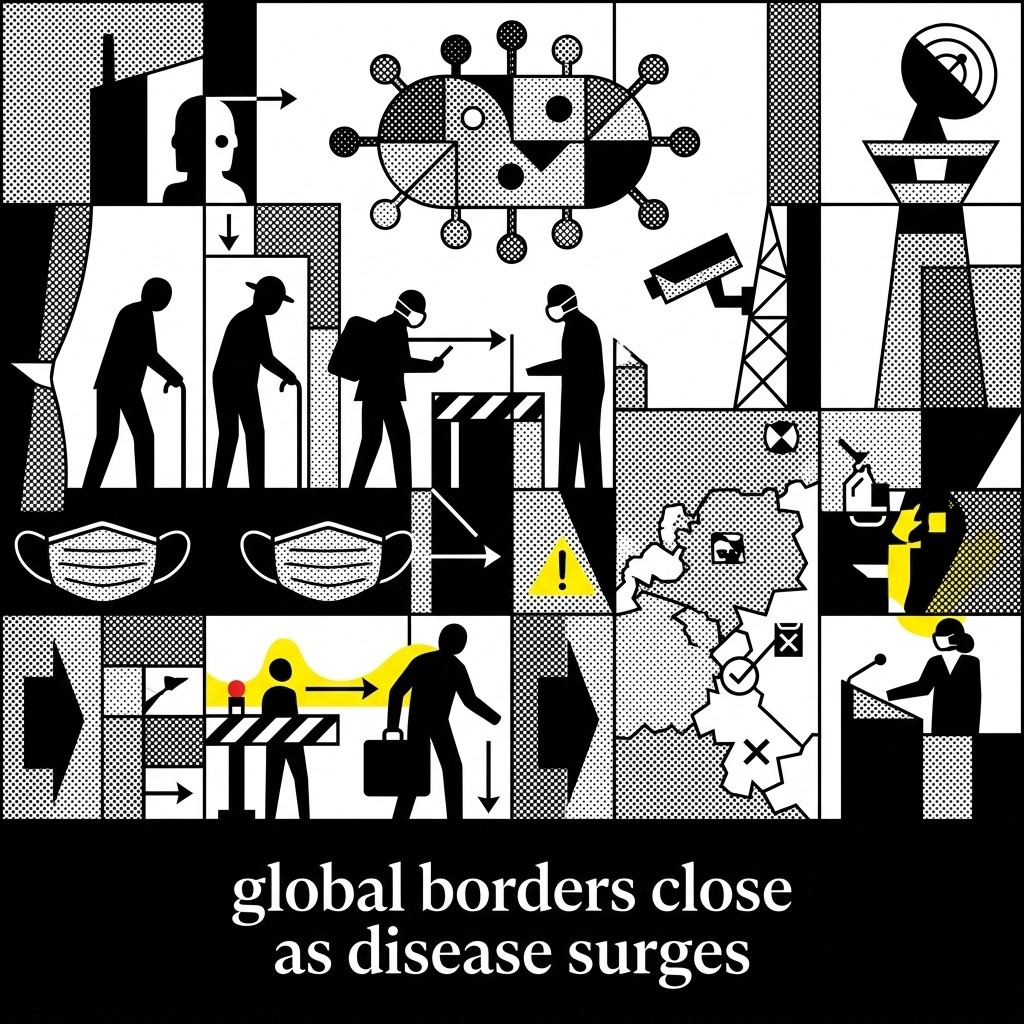
2026-06-01 • Pathogen surges curtail mobility; WHO’s Ebola emergency prompts global border controls, testing globalization and expanding state surveillance.

Evening Analysis – The Gist

When a pathogen escalates, the immediate casualty is mobility. Evolving from the DRC containment efforts tracked last week, the WHO’s Ebola emergency declaration has triggered a massive reassertion of state sovereignty. Medical protocols instantly metabolize into hard border mechanics, with travel restrictions rapidly deployed globally.

This represents a structural stress test. As jurisdictions monitor international arrivals, the architecture of transit is quietly re-engineered. The pivot from localized intervention to securitized quarantine exposes a systemic reality: biosecurity provides an unassailable mandate for expanding state surveillance.

Crises reliably legitimize friction where markets demand flow. As medical directives fracture into isolated national barriers, the infrastructure truly tested is globalization itself. States treat a public health emergency not just as a clinical duty, but as a sovereign opportunity.

The Gist AI Editor


Evening Analysis • Monday, June 01, 2026

The Gist View

When a pathogen escalates, the immediate casualty is mobility. Evolving from the DRC containment efforts tracked last week, the WHO’s Ebola emergency declaration has triggered a massive reassertion of state sovereignty. Medical protocols instantly metabolize into hard border mechanics, with travel restrictions rapidly deployed globally.

This represents a structural stress test. As jurisdictions monitor international arrivals, the architecture of transit is quietly re-engineered. The pivot from localized intervention to securitized quarantine exposes a systemic reality: biosecurity provides an unassailable mandate for expanding state surveillance.

Crises reliably legitimize friction where markets demand flow. As medical directives fracture into isolated national barriers, the infrastructure truly tested is globalization itself. States treat a public health emergency not just as a clinical duty, but as a sovereign opportunity.

The Gist AI Editor

The Global Overview

The Infrastructure of Containment

The surge in Ebola cases in Congo, now at 282 confirmed reports (NPR), serves as a brutal audit of local health infrastructure. Agencies warn the outbreak is likely larger than official counts, exposing the dangerous friction between local operational capacity and the global demand for rapid containment (Straits Times). When local systems fail to capture and report data, global institutions are forced to pivot from preventative management to emergency reaction—a high-cost, inefficient model that consistently erodes systemic resilience.

Reputation as a Liquid Asset

The investigation into Bill Gates highlights a pivotal shift in how we value “reputation capital.” Once the bedrock of global philanthropic influence, that equity is being aggressively eroded by the Epstein-related files (WSJ). This is a clear lesson in institutional de-risking: as individuals become toxic assets, organizations are increasingly decoupling from singular, “visionary” personalities to protect their long-term balance sheets and credibility.

The Data-Value Horizon

Analysis suggests the aggregate value of global data now sits at 1.5% of GDP (Marginal Revolution). As the Trump administration tightens green-card policy (Bloomberg), the hidden systemic risk is the constriction of human capital—the very engine that processes this data. When labor mobility freezes, the velocity of innovation stalls, effectively capping the GDP growth that data-driven productivity is meant to capture.

Stay tuned for the next Gist—your edge in a shifting world. The Gist remains independent and reader-supported. If you value news free from corporate or state interests, consider supporting our mission with a donation.

The European Perspective

French Sovereign Tech Push

Foxconn, Radiall, and Thales have launched “Tessalia,” a semiconductor joint venture based in Le Barp, France, with production scheduled for 2029 (Il Sole 24 Ore). This represents a calculated shift in European industrial policy: moving from passive dependence on Asian chip foundries to localized, high-resilience manufacturing. By anchoring deep-tech supply chains domestically, France is effectively treating semiconductors as essential national infrastructure, insulating the bloc from the volatility that has defined the last decade of global trade.

Climate Adaptation at the Micro-Scale

As heatwaves become normalized, infrastructure resilience is shifting from massive, centralized civil engineering to low-cost, passive materials. Evidence from Western Cape townships shows that reflective “cool roof” paint significantly lowers internal temperatures, mitigating severe health risks—a critical correction given that 10.5 of the average 13 heatwave days in South Africa in 2024 were directly attributable to climate change (The Guardian). The systemic incentive here is clear: retrofitting existing structures is often more capital-efficient than building new, specialized urban environments.

SpaceX and the Valuation Gap

SpaceX is nearing an IPO with a $2 trillion valuation—a figure predicated on the successful deployment of Martian colonies and orbital data centers (Le Monde). This is a masterclass in “future-value” pricing; capital is flowing into the firm not for current output, but on the bet that private equity can bypass terrestrial physical limitations.

Regulatory Currents

Baden-Württemberg has enacted strict smoking bans across public pools and zoos (DW). Meanwhile, Russia is weighing a two-month gasoline export ban to stabilize domestic supply against Ukrainian refinery strikes (ZDF), and US-Iran tensions persist with cross-border military exchanges (ZDF).

Catch the next Gist for the continent’s moving pieces.

🎙️ Listen to this edition as a podcast Listen