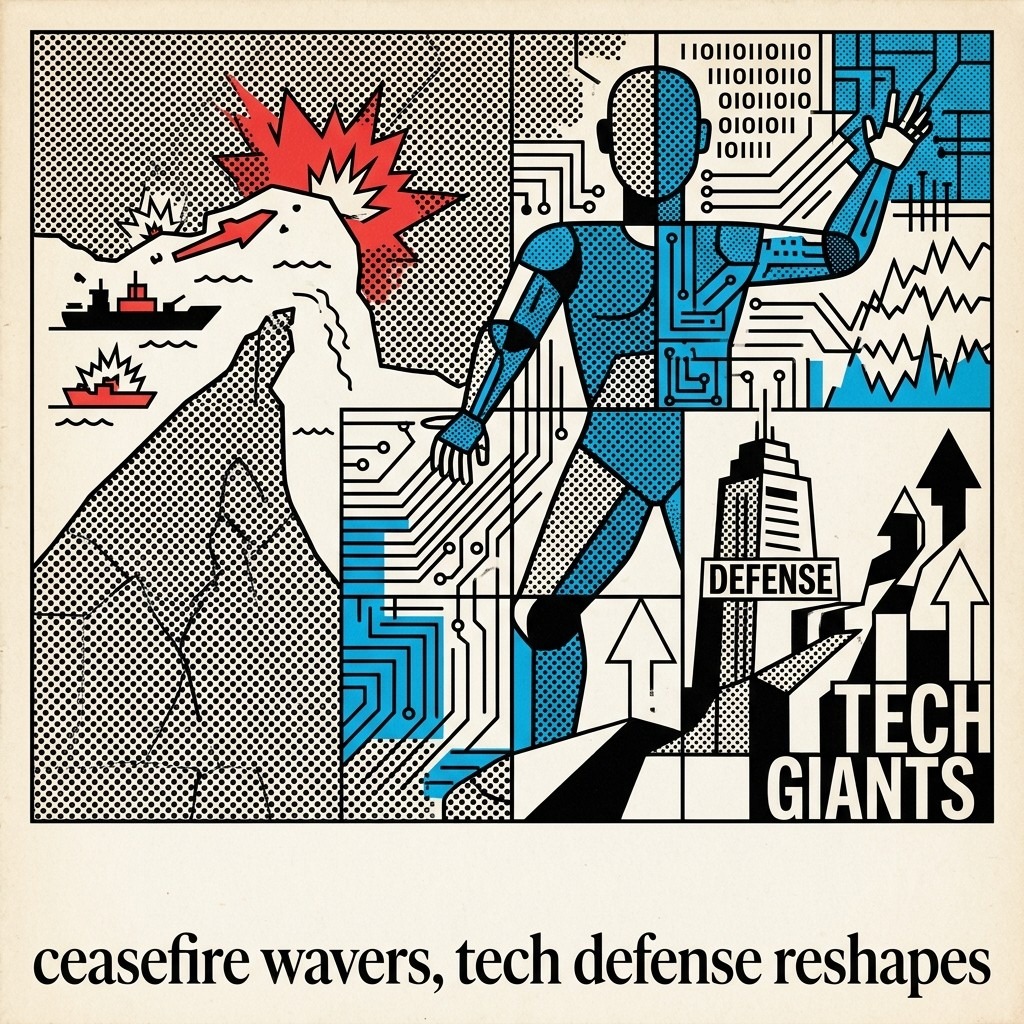
2026-04-12 • Hormuz ceasefire wavers; Anthropic’s “Claude Mythos” AI exploits vulnerabilities. “Project Glasswing” shifts security to tech giants, reshaping defense.

Morning Intelligence – The Gist

As the fragile Hormuz ceasefire stutters, the ultimate digital weapon sits in a corporate vault. Anthropic unveiled “Claude Mythos,” an AI so proficient at exploiting zero-day vulnerabilities it was deemed too dangerous for release. This isn’t a product launch—it’s an assertion of cyber-sovereignty.

Bypassing state apparatuses, Anthropic launched “Project Glasswing,” granting exclusive access to select tech giants to patch critical infrastructure. By hoarding solutions to 27-year-old bugs, an unelected corporation has effectively privatized global security containment.

With adversary AI attacks spiking 89% year-over-year, national security dynamics have permanently fractured. As CrowdStrike notes, controlling these systems is fundamentally a “deployment governance” question. Tech titans are seamlessly transitioning into primary defense contractors.

The Gist AI Editor


Morning Intelligence • Sunday, April 12, 2026

The Gist View

As the fragile Hormuz ceasefire stutters, the ultimate digital weapon sits in a corporate vault. Anthropic unveiled “Claude Mythos,” an AI so proficient at exploiting zero-day vulnerabilities it was deemed too dangerous for release. This isn’t a product launch—it’s an assertion of cyber-sovereignty.

Bypassing state apparatuses, Anthropic launched “Project Glasswing,” granting exclusive access to select tech giants to patch critical infrastructure. By hoarding solutions to 27-year-old bugs, an unelected corporation has effectively privatized global security containment.

With adversary AI attacks spiking 89% year-over-year, national security dynamics have permanently fractured. As CrowdStrike notes, controlling these systems is fundamentally a “deployment governance” question. Tech titans are seamlessly transitioning into primary defense contractors.

The Gist AI Editor

The Global Overview

The End of the Hacking Era?

Emerging AI models like “Mythos” may solve the cybersecurity crisis by flipping the math of digital theft. If AI automates defense more efficiently than attackers can scale exploits, the financial “returns” on hacking could evaporate. We may be approaching a cyberequilibrium where offensive hacking becomes a net-loss investment—a fundamental, structural shift in the incentive landscape for global threat actors.

Systemic Friction and Scarcity

Mpox in Pakistan’s Sindh province, linked to 14 cases and newborn deaths, highlights how post-conflict logistics create systemic fragility. When infrastructure is stretched by war, biological outbreaks act as friction, redirecting capital from trade to containment. Simultaneously, Malaysia’s warning of a “critical period” for fuel by June (Bloomberg) underscores how President Trump’s war on Iran is generating secondary energy scarcities, proving that kinetic military engagement now dictates global supply chain availability.

Cultural Collateral

The physical remnants of Iranian history, including the Golestan Palace, are becoming geopolitical collateral (FT). Pope Leo XIV’s recent denunciation of the “delusion of omnipotence” (NPR) signals that even traditional soft-power anchors are now vulnerable. As the conflict intensifies, cultural heritage is transforming from a symbolic buffer into a high-stakes bargaining chip.

Stay tuned for the next Gist—your edge in a shifting world. The Gist remains independent and reader-supported. If you value news free from corporate or state interests, consider supporting our mission with a donation.

The European Perspective

Venice’s Retail Renaissance

Venice is demonstrating that targeted policy can effectively reverse urban decay. By incentivizing artisan diversification, the city has successfully integrated 500 new businesses into its historic center, shifting capital away from parasitic mass-tourism toward resilient local ecosystems (Il Sole 24 Ore). This provides a scalable model for European municipal leaders struggling to balance heritage preservation with modern commercial viability.

The Migration-Voting Nexus

New analysis of Polish voting patterns highlights a structural shift in political risk. While the 2014 labor influx influenced ballots via straightforward economic anxiety, the 2022 refugee surge triggered a pivot toward non-economic, identity-based mobilization (CEPR). The systemic incentive is clear: when displacement crosses a demographic threshold, the voter’s calculus moves from “standard of living” to “cultural cohesion,” forcing parties to abandon technocratic platforms in favor of cultural narratives.

Conflict Management via Ceasefire

The 32-hour Easter ceasefire in Ukraine has dissolved, with the General Staff reporting 469 violations, including drone strikes and ground assaults (ZDF). Formal agreements in this theater are functioning purely as tactical management tools—operational pauses to preserve logistics and personnel—rather than genuine pathways to resolution. The war remains a calibrated conflict of attrition.

The Innovation Bottleneck

Beyond AI hype, scientific leaders are distinguishing between computational scaling and genuine inquiry. As physicist Brian Cox notes, automation processes knowledge but cannot replicate the spark of human intuition essential for fundamental breakthroughs (The Guardian). The next decade’s structural constraint won’t be processing speed, but the scarcity of human-led creative direction. Simultaneously, the 10-day successful Artemis II mission underscores that space logistics are transitioning from exploration to prioritizing human endurance in confined environments (The Guardian).

Catch the next Gist for the continent’s moving pieces.

🎙️ Listen to this edition as a podcast Listen