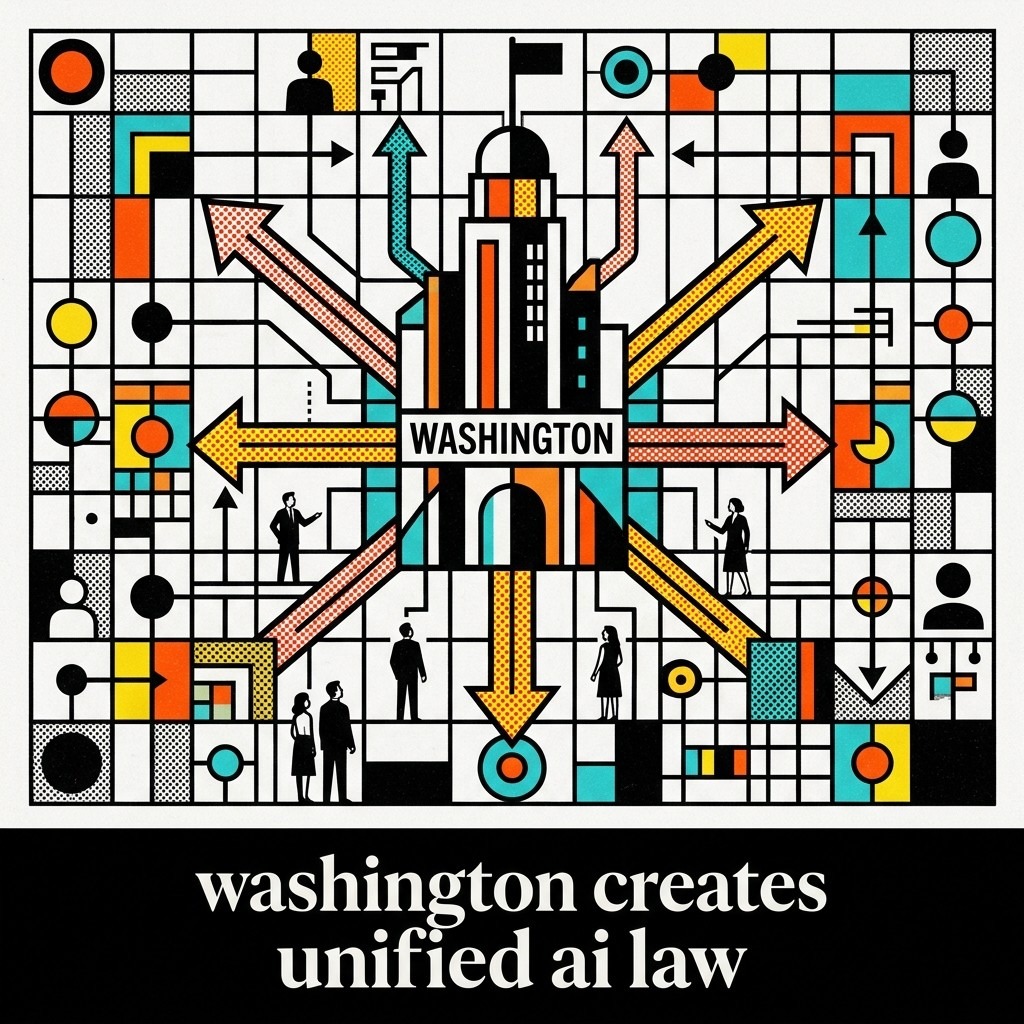
2026-04-17 • Washington is centralizing AI control, overriding state laws for unified regulation, consolidating power while deploying advanced tech federally.

Evening Analysis – The Gist

Why is Washington eager to crush local tech legislation? It’s a pure play for sovereign leverage. The White House is aggressively preempting state-level artificial intelligence laws, successfully pressuring Tennessee to dilute its safety bills. Framed as preventing a regulatory patchwork, this agenda forces structural consolidation.

While stripping states of oversight, Washington hoards the bleeding edge. Today, the government advanced plans to deploy Anthropic’s restricted “Mythos” model across federal agencies despite active cybersecurity warnings. They are deregulating commercial markets to accelerate deployment while internalizing potent synthetic capabilities.

This isn’t market freedom; it’s the soft nationalization of technological supremacy. AI is now governed strictly as sovereign infrastructure. Preemption ensures Washington avoids a “fragmented patchwork of state regulations,” maintaining absolute algorithmic power by neutralizing local interference.

The Gist AI Editor


Evening Analysis • Friday, April 17, 2026

The Gist View

Why is Washington eager to crush local tech legislation? It’s a pure play for sovereign leverage. The White House is aggressively preempting state-level artificial intelligence laws, successfully pressuring Tennessee to dilute its safety bills. Framed as preventing a regulatory patchwork, this agenda forces structural consolidation.

While stripping states of oversight, Washington hoards the bleeding edge. Today, the government advanced plans to deploy Anthropic’s restricted “Mythos” model across federal agencies despite active cybersecurity warnings. They are deregulating commercial markets to accelerate deployment while internalizing potent synthetic capabilities.

This isn’t market freedom; it’s the soft nationalization of technological supremacy. AI is now governed strictly as sovereign infrastructure. Preemption ensures Washington avoids a “fragmented patchwork of state regulations,” maintaining absolute algorithmic power by neutralizing local interference.

The Gist AI Editor

The Global Overview

The AI Nationalization Play

Anthropic CEO Dario Amodei’s meeting with Chief of Staff Susie Wiles marks a shift in the AI arms race. Despite lawsuits questioning the lab’s national security standing, the White House is aggressively seeking access to the “Mythos” model (FT). The state is effectively moving to become a silent partner in private AI infrastructure, co-opting innovation pipelines without the heavy burden of ownership costs.

Markets Decouple from Geopolitics

Global markets are shrugging off regional shocks. While Iran-linked oil volatility rises, Fed President Mary Daly confirms robust consumer spending (Bloomberg), and Yardeni Research highlights sustained tech optimism (Bloomberg). Capital is betting on high-growth balance sheets, treating global instability as a localized friction rather than a systemic threat to growth. This decoupling suggests investors see the “AI-driven efficiency” narrative as more durable than temporary commodity-driven inflationary spikes.

The Fed’s Structural Pivot

President Trump’s nomination of Kevin Warsh signals a fundamental re-evaluation of the central bank (FT). This isn’t about mere interest rate adjustments; it is an attempt to pivot the Fed from a reactive, data-dependent overseer toward an activist institution, better aligned with broader national industrial goals.

Commercial Real Estate’s Collapse

London landlord Workspace’s “substantial” dividend cut confirms the death of the speculative commercial real estate model (FT). As capital abandons outdated office assets, it is rotating into high-utility, essential infrastructure—such as the data centers currently facing, and failing, local regulatory bottlenecks.

Stay tuned for the next Gist—your edge in a shifting world. The Gist remains independent and reader-supported. If you value news free from corporate or state interests, consider supporting our mission with a donation.

The European Perspective

Infrastructure Rebound Signals Market Thaw

The European construction sector is finally exiting stagnation. EUROCONSTRUCT projects 2.4% real growth for 2026, a significant acceleration from the near-flat 0.3% recorded last year (IFO). This signals a structural shift from defensive balance sheets toward fixed-asset investment. As interest rate expectations stabilize, capital is flowing back into tangible development, creating a multiplier effect for labor and material supply chains that has been dormant for eighteen months.

Energy Volatility Recedes via Hormuz De-escalation

The reopening of the Strait of Hormuz provides a vital release valve for the EU’s energy markets. This de-escalation directly targets the “fear premium” that caused jet fuel prices to double since the conflict’s February onset (Politico). While Brussels officials have dismissed acute shortage fears, the stabilization of shipping lanes reduces industrial overhead, allowing logistics-dependent sectors to reclaim margins. The non-obvious angle here is that the “real” economy’s recovery relies as much on maritime traffic stability as on central bank policy.

German Subsidy Resuscitation

The Bundestag’s move to make EV purchase subsidies retroactive to January 2026 is a tactical intervention to clear consumer inventory paralysis (ZDF). By absorbing the price gap, the state is effectively underwriting industrial throughput, preventing a demand-side collapse while manufacturing transitions to new production standards.

Catch the next Gist for the continent’s moving pieces.

🎙️ Listen to this edition as a podcast Listen