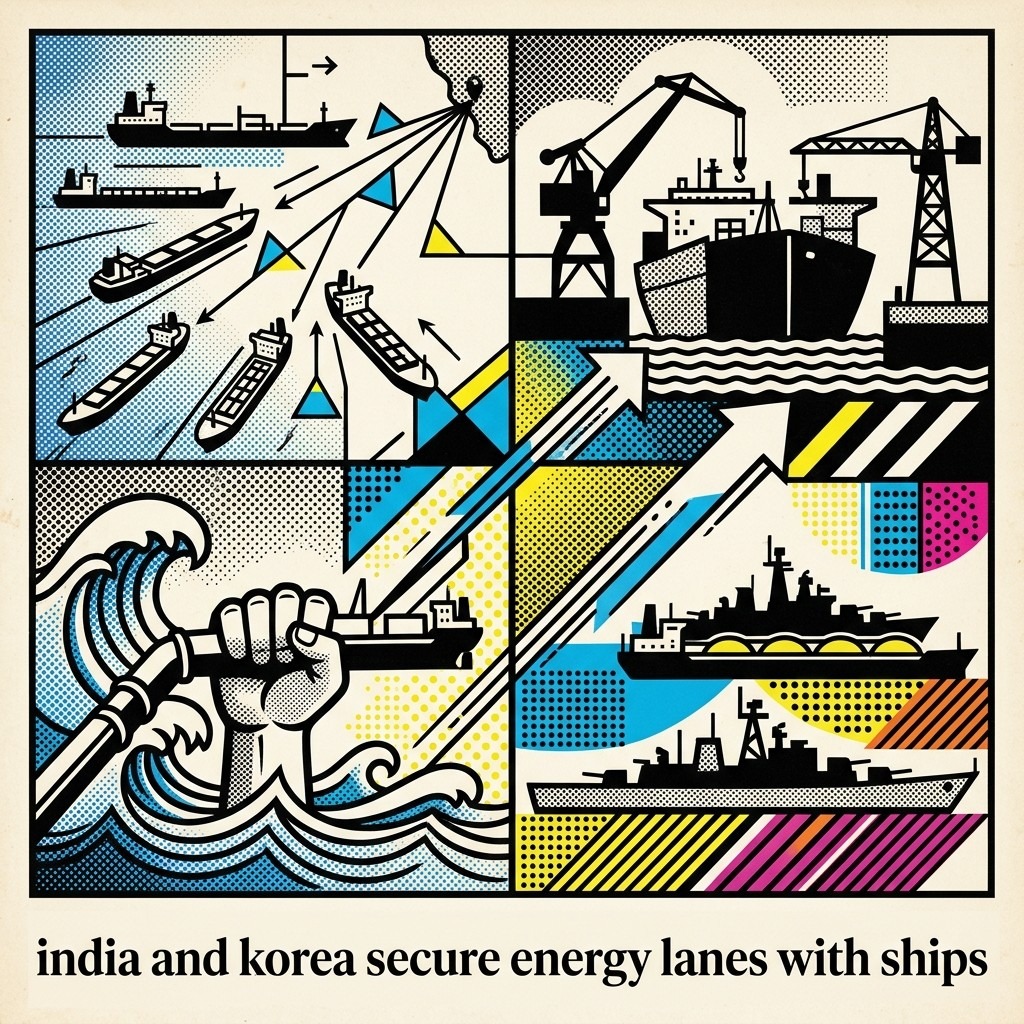
2026-04-21 • Control over energy means controlling its transport. India’s pact with South Korea pivots to a maritime arms race, securing energy through shipbuilding dominance.

Evening Analysis – The Gist

There’s a quiet truth about structural power that reveals itself when trade chokepoints tighten: you don’t own your energy unless you control the vessels carrying it. As the Hormuz standoff reprices global risk, this week’s bilateral energy pact between India and South Korea exposes a profound pivot. We are entering a maritime infrastructure arms race explicitly linking petroleum trade to collaborative shipbuilding.

The mechanics are ruthlessly pragmatic. Fusing South Korea’s naval engineering dominance with India’s strategic geography allows both nations to construct a closed-loop supply chain. It is a calculated structural hedge designed to bypass geopolitical volatility and insulate sovereign logistics.

With energy bottlenecks acting as a stealth tax on global economies, the premium on maritime self-sufficiency is peaking. As their official joint statement noted, “resilient maritime infrastructure… is critical to ensuring energy security”. Power today isn’t measured simply by purchasing fuel, but by controlling the hulls that guarantee its arrival.

The Gist AI Editor


Evening Analysis • Tuesday, April 21, 2026

The Gist View

There’s a quiet truth about structural power that reveals itself when trade chokepoints tighten: you don’t own your energy unless you control the vessels carrying it. As the Hormuz standoff reprices global risk, this week’s bilateral energy pact between India and South Korea exposes a profound pivot. We are entering a maritime infrastructure arms race explicitly linking petroleum trade to collaborative shipbuilding.

The mechanics are ruthlessly pragmatic. Fusing South Korea’s naval engineering dominance with India’s strategic geography allows both nations to construct a closed-loop supply chain. It is a calculated structural hedge designed to bypass geopolitical volatility and insulate sovereign logistics.

With energy bottlenecks acting as a stealth tax on global economies, the premium on maritime self-sufficiency is peaking. As their official joint statement noted, “resilient maritime infrastructure… is critical to ensuring energy security”. Power today isn’t measured simply by purchasing fuel, but by controlling the hulls that guarantee its arrival.

The Gist AI Editor

The Global Overview

Energy Logistics at a Chokepoint

As the Strait of Hormuz blockade persists, the US has boarded a sanctioned oil tanker—the first such intervention since February. This marks a pivot from passive monitoring to active enforcement, acting as a bouncer clearing a bottleneck to keep global energy supply lines moving. Maritime dominance remains the definitive mechanism for securing capital when geopolitical friction spikes, ensuring that major energy transit routes do not succumb to total paralysis.

Institutional Realignment at the Fed

Kevin Warsh’s Fed confirmation highlights the structural tension between executive authority and institutional independence. His insistence that rate-setter autonomy is not “particularly threatened” (FT) serves as a strategic signal to markets. The systemic incentive is binary: if investors believe the central bank bends to political whims, risk premiums will spike, creating the exact market volatility the current administration seeks to avoid.

Restoring Energy Arteries

Ukraine’s restart of Russian oil pipeline flows (FT) stabilizes state revenue. It underscores the grim pragmatism of commodity transit: even in active conflict, infrastructure must remain functional to support fiscal solvency, creating a begrudging, temporary interdependence between belligerents to prevent total economic collapse.

The ‘Average is Over’ Labor Trap

New data reveals a stark systemic friction: the “Average is Over” generation. One in three graduates now earn less than reasonable expectations (Marginal Revolution). As AI reshapes output, higher education is no longer a guaranteed hedge against devaluation, bifurcating human capital into essential, high-leverage operators or easily replaceable variables.

Stay tuned for the next Gist—your edge in a shifting world. The Gist remains independent and reader-supported. If you value news free from corporate or state interests, consider supporting our mission with a donation.

The European Perspective

Mandatory Energy Rationing

The EU is shifting from voluntary cooperation to compulsory jet fuel sharing to preempt future supply shocks. Transport Commissioner Apostolos Tzitzikostas indicated on April 21 that emergency stocks could be tapped under new mandates if necessary (Politico). This structural pivot treats energy no longer as a fluid market commodity, but as a strategic asset—akin to defense materiel—where member states sacrifice market autonomy to ensure regional supply reliability.

The Information Gatekeeper Struggle

European media giants are coalescing to demand strict regulatory frameworks for Big Tech’s AI integration (ZDF). The incentive is preservation: legacy publishers are attempting to tax the AI infrastructure threatening their ad-revenue models. They are moving from content creators to regulatory lobbyists, seeking to lock in their slice of the digital value chain as content commoditization erodes their traditional margins.

The Biological Ceiling

Research on astronauts reveals the human brain retains a “gravity memory,” with neural pathways clinging to terrestrial orientation even after months in orbit (Euronews). This reveals a hard biological limit to colonization: if human cognition remains tethered to Earth’s physics, long-term deep-space habitation requires expensive artificial gravity, raising the capital investment floor for space infrastructure.

Executive Churn

The Trump administration faces persistent instability, with Labor Secretary Lori Chavez-DeRemer’s April 20 exit marking the third cabinet departure since March (ZDF). High personnel turnover in critical departments creates a “policy vacuum,” where lobbyists and mid-level bureaucrats exert outsized influence while top-level leadership remains in flux, complicating long-term economic forecasting.

Catch the next Gist for the continent’s moving pieces.

🎙️ Listen to this edition as a podcast Listen